
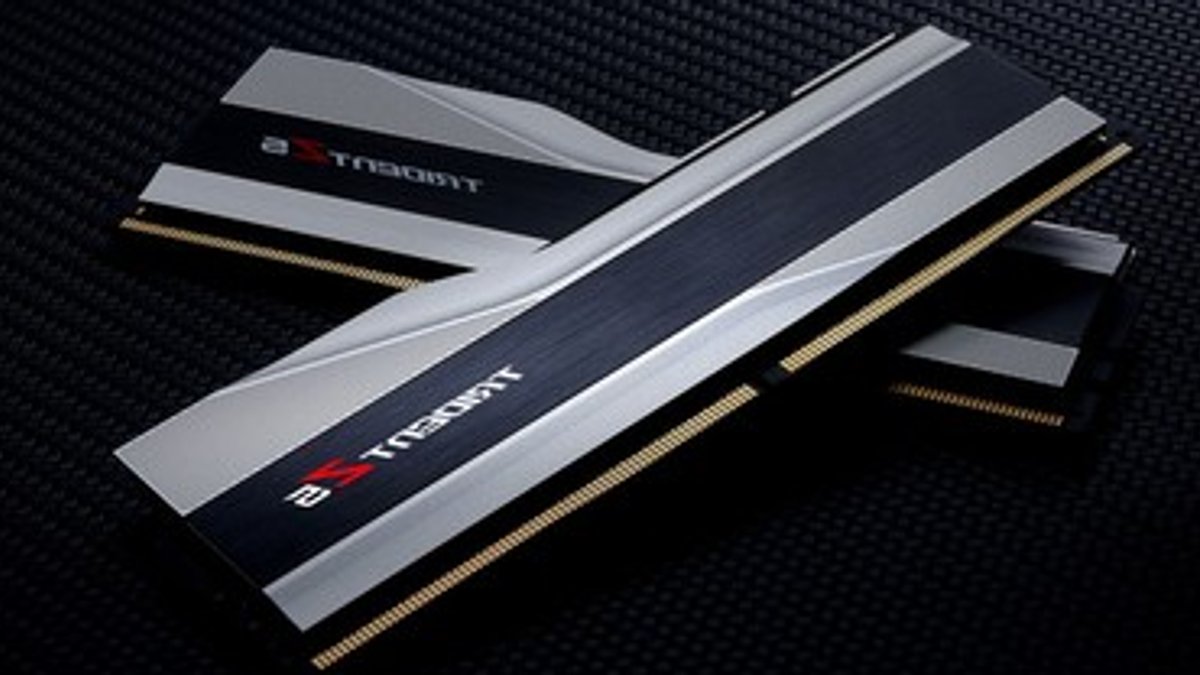
G.Skill has unveiled what it claims are the world’s first DDR5-6600 memory kits, pushing the speed of consumer RAM ahead of competitors still shipping DDR5-4800 or DDR5-6400 modules with looser timings. The announcement arrives as the industry prepares for the debut of the first consumer desktop PC platforms that support DDR5. While earlier reports highlighted Corsair’s DDR5-6400 kits, G.Skill’s latest offering leapfrogs that specification by an additional 200 MHz, setting a new benchmark for out-of-the-box performance. The move shows the rapid pace of development in the memory market, where manufacturers are racing to establish dominance before mainstream adoption begins.
The new Trident Z5 DDR5-6600 CL36-36-36-76 kits come in 32 GB pairs (2×16 GB). These kits target early adopters who demand maximum bandwidth and minimal latency, particularly in high-end gaming and content creation workloads. The advertised CAS latency (CL) of 36 is notably tighter than the CL40-40-40 timings found on many rivals’ DDR5 memory, as well as lower headline data transfer rates. G.Skill says its new DDR5-6400 kits are “the world’s first DDR5 memory kits,” and it has validated their use at “an extreme speed and low latency of DDR5-6600 CL36-36-36-76.”
Creating the Trident Z5 DDR5-6600 32GB memory kits follows a familiar story line to the one we have heard from G.Skill over the years. It sources high-performance Samsung DDR5 ICs and picks through them to create its matched validated sets. G.Skill reckons this process makes its memory kits “the ultimate performance choice for gamers, enthusiasts, and overclockers.”
No pricing or release date has been announced. Industry estimates suggest DDR5 could carry a 30–50% premium over equivalent DDR4 kits, and G.Skill’s high-end modules are likely to sit at the upper end of that range. The premium reflects not only the cost of the ICs themselves but also the additional engineering required to stabilize such high frequencies. Early DDR5 adopters will also need compatible motherboards with robust power delivery systems, as the memory standard introduces a new 12V power management IC (PMIC) that handles voltage regulation on the module itself. This shift reduces the load on the motherboard’s VRMs but adds complexity to the memory design, further contributing to the higher cost. For users upgrading from DDR4, the transition will require a new CPU, motherboard, and potentially a new power supply, making the overall investment substantial.
RGB and non-RGB variants coming
The Trident Z5 family will include two versions: a standard model with a glossy black top bar and an RGB variant featuring a translucent light bar for smooth illumination. The non-RGB model retains the sleek, understated aesthetic that has been a hallmark of the Trident Z series. In contrast, the RGB version incorporates G.Skill’s signature lighting design, which uses a diffused light bar to create even, lively illumination without hotspots. This design choice ensures compatibility with popular RGB software ecosystems, including ASUS Aura Sync, MSI Mystic Light, and Gigabyte RGB Fusion. The translucent bar also serves a functional purpose, as it helps distribute light more evenly than traditional RGB implementations, which often rely on discrete LEDs.
Related: Corsair unveils AiO coolers with circular LCD panels
G.Skill has not yet published a full product matrix, so exact configurations beyond the 32 GB DDR5-6600 kit remain unclear. Historically, the company has offered its memory kits in a range of capacities and speeds, from entry-level options to extreme overclocking modules. The Trident Z5 series is likely to follow a similar pattern, with lower-speed kits appearing alongside the flagship 6600 MHz model.
Memory speeds have historically climbed in small increments, but DDR5’s arrival marks a sharper jump. When DDR4 launched in 2014, the fastest kits topped out at 3200 MHz; today, DDR5-6600 is already in sight before the first consumer platforms even ship. This acceleration is driven by several factors, including advancements in semiconductor manufacturing, improved signal integrity techniques, and the introduction of on-module power management. DDR5 also doubles the burst length from 8 to 16, allowing for more data to be transferred per clock cycle, which further boosts effective bandwidth. These architectural improvements mean that even at the same clock speed, DDR5 can deliver significantly higher performance than DDR4, making the transition more compelling for users who demand the latest technology.
The shift to DDR5 also brings changes to how memory is addressed and managed. The standard introduces a new command/address (CA) bus architecture, which reduces the number of pins required for communication between the CPU and memory modules. This change simplifies motherboard design and allows for more efficient routing of traces, which can improve signal integrity at high speeds. Additionally, DDR5 supports higher-capacity modules by enabling more densely packed ICs, paving the way for future kits with capacities that were previously impractical. For example, while DDR4 maxed out at 32 GB per module for consumer use, DDR5 could theoretically support 128 GB or even 256 GB modules in the future, though such capacities are likely to remain in the server and workstation markets for the foreseeable future.
For now, the kits exist only as a press announcement. Once retail samples arrive, reviewers will test whether the promised latency and bandwidth gains translate into real-world performance—or if the premium is justified only for benchmark runs. Early adopters will need to weigh the benefits of DDR5’s higher speeds against its current limitations, such as the lack of widespread platform support and the potential for initial compatibility issues. The first consumer desktop PC platforms that support DDR5 are expected to fully leverage its capabilities, but even then, the performance uplift may vary depending on the workload. As more DDR5-compatible systems hit the market, the true value of G.Skill’s Trident Z5 kits will become clearer.

